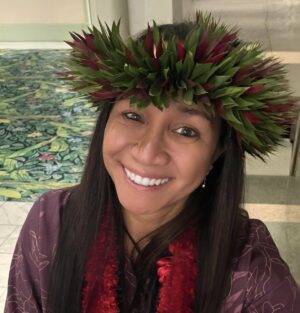
Josette Kaleolani Akim Hanohano
- Island: Oahu
- District: Windward
- Class: Social Studies-Modern History of Hawai`i `Āina Momona: E Malama Mauka i Makai
- Years of Teaching: 34
- Field/Office: Kahuku High & Intermediate School
- Complex Area: Castle-Kahuku (CK Windward)
- Home Town: Lā`ie, O'ahu
What do you love about teaching in Hawaiʻi?
Teaching in Hawaiʻi is an extraordinary privilege, especially when you extend your curriculum far beyond the four walls of the classroom. I love how deeply education is woven into mālama ʻāina (stewardship) and community, where lessons are grounded in the rich wisdom of our kūpuna. There is a unique joy in guiding a diverse, warm-hearted student body that teaches you just as much as you teach them. Ultimately, it is a true “”work of the heart”” fueled by shared aloha. This path is a gift that provides a stable livelihood, allowing homegrown educators like myself to live in harmony with the islands’ beautiful, outdoor-centered lifestyle. Here, I am able to practice the values of aloha with authenticity. The teaching is embedded in the soil, written in the sky, sung on the waters, and danced on the shores. These environments provide intuitive lessons that ignite curiosity, gratitude, and eternal love for Hawaiʻi nei.
What do you value as a strength of the Hawaiʻi Department of Education?
What I value most as a core strength of the Hawaiʻi Department of Education is its systemic commitment to Nā Hopena Aʻo (the HĀ framework). This unique, statewide foundation ensures that cultural values like aloha and mālama are structurally supported in every classroom, rather than treated as afterthoughts. It allows teachers to earn a meaningful living while doing work that genuinely respects, honors, and preserves the soul of this community.
What do you value as a strength of your particular school or office? What is your complex area known for?
Kahuku High & Intermediate School is extraordinary because of our absolute dedication to pilina—meaningful, deeply rooted relationships with our students. We believe this bond must precede academic success, so our entire school climate is built on the strength of these connections. From the front office to every classroom, you feel a profound sense of togetherness and aloha. This spirit extends far beyond our campus; drive past the Malaekahana stretch, and you will see fences decorated by the community for every student milestone. You might even witness a spontaneous parade circling Lāʻie, Hauʻula, and Kahuku, where aunties and uncles cheer for our students’ triumphs. Here, every achievement is a collective victory. We succeed because, for generations, we have met the challenge of showing up for our kids, holding space through hardship, and expressing an elevated level of care for one another, through the best and worst of times.
What is unique/special about your school and/or community? What do you enjoy most about teaching there?
Kahuku is defined by its humble beginnings and a legacy of resilience that persists today. Our school’s spirit is woven into stories like the one of our iconic red-and-white colors, born when ʻIolani School gifted our fledgling football team their first jerseys and pads—a gesture that sparked a program that is now revered across the nation as a gridiron powerhouse . We thrive despite dated facilities because our strength is found in our people. It is common to see intergenerational graduates return as coaches, teachers, and principals, each wanting to be counted, and locked in when students need to mentor, guide and lead. We are blessed with an incredible network of unsung local heroes and alumni who continuously pour their hearts, time, and resources back into the needs of our students, teachers, facilities, programs, and teams. The legacy comes full circle in leaders like Walter Santiago—a proud 1988 graduate of Kahuku who went from student, to teacher, to interim football coach, and who now leads us forward as our dedicated principal.
What are 2 main challenges you face (or you feel teachers face) as an educator in Hawaiʻi?
Our students possess limitless potential, but they are constantly forced to overcome limitations they did not create. The deepest challenge is meeting their evolving needs when the system lags behind. First, we must bridge the physical and cultural divide. Connecting youth to their heritage and future careers requires consistent funding for ʻāina-based huakaʻi (field trips). Rising transport, airfare, and fees restrict our capacity to take learning beyond the classroom, locking students out of the possibilities they are meant to lead. Second, we must modernize our learning environments. Our facilities require immediate, systemic attention—from reliable Wi-Fi to restoring crumbling infrastructure. It is a heavy emotional toll to foster focus and real-world skills when classrooms hit 96°F and everyone is melting.
What are the qualities that make a Hawaiʻi Department of Education educator successful? Explain.
To be a successful educator in Hawaiʻi, you need a heart rooted in kūleana and an unwavering commitment to show up for our keiki every single day. It takes real grit to teach through rising costs, traffic, tropical heat, and aging classrooms. You must be built of loʻi mud, country air, and ocean spray, turning daily struggles into lessons of resilience and pride. Ultimately, success isn’t about fancy facilities. It is about loving this ʻāina deeply, weaving community into your curriculum, and nurturing deep relationships of trust and aloha with the families who entrust their children to you. Knowing your kūleana and carrying a purposeful pedagogy—a pathway that burns brightly at your school—is the true hallmark of a quality educator.
What words would you use to describe your students? Explain.
Akahai (kindness), Lōkahi (unity), and Kūleana (responsibility) describe the kind of learners my students are. Living in the rainforest of Koolauloa we know learning is an active connection with Papa (mother earth). In my Modern Hawaiian History course, 11th-graders don’t just study history—they sweat for it and restore it. The lessons are already stored in their bones. As true stewards of our ʻāina, they extract invasive seaweed, cultivate kalo at K & K Farms, and restore ancient loko iʻa at Loko Ea. In these moments they explore ancestral engineering withāina literacies specific to Koolauloa. Here they are scientists at play. Our classroom extends from ridge to reef, where students deeply grasp our past. This place-based journey brings the Spirit of alohaāina to life. Navigating heavy historical truths with these values, they develop culminating Legacy Action Plans that masterfully showcases the ideals of a Kahuku graduate. My students transform into pono leaders who are ready to nurture family, care for place, and serve their community.
Free time: What are some fun activities that people can enjoy doing outside school hours on the island that you work at?
Living in Koʻolauloa offers endless opportunities to connect with the people, explore the mountains and valleys, and swim in the ocean. You can learn to paddle an outrigger canoe in Kahana, snorkel at Kapoho in Paumalū, and paddle board in Kawailoa. For those seeking adventure on land, you can hike the lovely, rugged trails of Kaʻena and enjoy a horseback ride under the stars in Malaekahana. Additionally, visiting the Polynesian Cultural Center in Lā`iemalo’o offers a wonderful way to celebrate our rich, diverse Pacifika heritage with family and friends.
Free time: What are some fun activities that you personally enjoy doing on the island or complex area/neighborhood you work in?
I enjoy hiking and traveling to new places. I’ve been learning to free dive this year, which has been a new and exciting way to connect with the ocean as well as myself. As I learn to hold my breath, it forces me to focus on listening to my body’s signals and be present with my thoughts.
What do you enjoy most about the students you teach in Hawaii?
Every extra minute I get is spent with my ʻohana, where we gather in the kitchen and around the fire to teach our children traditional culinary recipes—wrapping laulau, cooking pig in the underground imu, gathering at the shoreline to catch fish for fresh poke, and preparing sweet kūlolo pudding simply because we love good Hawaiian food. When we aren’t cooking, we are on the mighty moana (ocean) outrigger paddling and surfing. You can usually find us playing in Kalaeloa, waxing up our papahe`enalu (surfboards) to catch the rolling waves at Kalehuawehe. Some of our most cherished times are spent camping in Punaluʻu, where we sing sweet island songs, share stories about elders and ancestors, swim in the icy cold stream and make guava jam.
What’s your favorite local food on your island? -OR- Where’s your favorite place to eat on the island? Describe the food!
In Hawaii, food isn’t just about refueling—it is how we show love, celebrate, and bring our big ʻohana together. When we aren’t cooking at home, a few beloved local spots feel like an extension of our own kitchens. These are a few of my North Shore foodie Hot Spots! Across from Kahuku High School, nothing is better than feasting on a stack of Korean-style Kalbi with a side order of peeled garlic shrimp from Two Bald Guys food truck. Come hungry and ready to stand in line. For a “fresh from the aina” treat, I always head to Kahuku Farms for their farm-grown açaí bowls and legendary lilikoʻi butter mochi. Bring your laptop, find a picnic table and enjoy. On those days when the meetings or PD at the district office finished on time, it is a mandatory stop at Waiahole Poi Factory for smokey kalua pig, fresh squid lūʻau, and hand-pounded poi. I never leave before having a heavenly “”Sweet Lady of Waiahole.”” It’s what dreams are made of! When celebrating the end of a school year, or a colleague, we make it important to gather at Haleiwa Joe’s Haiku Gardens. The fresh poke nachos, and daily catch with ginger pesto is divine.The line is long for their legendary prime rib, and they don’t take reservations. Hawai`i is the mecca of global fusion, with new delights on every corner. Sharing a meal, picking up shaved ice or a sweet treat and gathering with colleagues as friends is a tasty lei of aloha.
What are some housing tips that you could recommend for teachers relocating to Hawaiʻi?
Relocating to Hawaiʻi to teach at a Windward District school requires realistic planning and a deep commitment. Visit beforehand, connect with the principal, and experience the Koʻolauloa commute. To avoid scams, never rent sight-unseen; book a short-term stay and utilize local teacher networks on Facebook and Instagram to find housing near your school. If you secure a home in Kahuku, embrace the rural, coastal reality. You will likely rent an older home or an ʻohana unit without A/C, relying on natural trade winds to stay cool. Life here is shaped by a single two-lane highway vulnerable to surf, rain, and traffic delays. Protecting our ʻāina and managing waste mindfully are shared, hands-on responsibilities. Give your ʻohana two years to adjust to this unique environment. Once settled, teaching at Kahuku will be one of the most grounding, rewarding experiences of your career.
What advice would you give to a new teacher who wants to work in your complex area or for the Hawaiʻi DOE in general?
The Castle-Kahuku Complex is far more than just a school district; it is a unique community with its own rich history and distinct ways of understanding our students’ needs. When you arrive, clearly pause and take in the majesty of the sheer cliffs of Konahuanui and then follow the guidance of your mentors, attend all informational meetings, and consider bringing makana (gifts or treats) for the front office staff. In Hawaiʻi, sharing small treats and notes of gratitude is a natural part of our professional culture—it shows you are eager to build positive relationships. Every small gesture of gratitude leaves a BIG and positive impression. Receiving that initial call from the principal at Kahuku High & Intermediate School means you are joining a dedicated group of smart and careful people who deeply value collaboration, professional development, and shared responsibility. Your patience, humility, and willingness to learn the rhythm of this community will quickly earn the trust and respect of the faculty, staff, students, and their families.